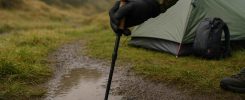
In no time a small campsite can become a cluttered mess. The rain jacket from the car is carelessly tossed near the tent entrance. Cooking equipment is spread out all over the ground. Shoes are scattered about blocking access to the sleeping area. In addition to looking untidy, such loose camping gear can soon become soggy, get in the way and be forgotten on the day of departure. So organization of a campsite involves setting up the best access routes and trying to keep items visible while also being protected from the weather as much as possible. You don't need to bring any extra storage space with you.
Start with the walking route, not the storage container
Identify your main routes first and set up the storage to surround these areas. Start by unpacking along the entrance route to the tent and then the paths to the cooking area and to water etc. and stores that sit along these routes can then be loaded in around the packing for these areas.
Do a quick tour of your tent after the initial setup and check if you can still leave with it in the dark. Can you open and close the door easily? If not then sort the problem immediately. Small problems can hide until the camp is in chaos.
Store heavy objects on the ground in stable stacks, not leaning up against the tent or clipping to the side of it. A folded up chair, a big water container, packed up cooking box etc all get stored down low in the corner of a tent to stop them falling over and blocking a path.
Give each item a small, repeatable home
Organizing your camping gear so that frequently used items are stowed in small areas to be used as necessary and then returned to the storage area after use is a big part of a well organized campsite. Using several bags to store different items and a lidded box for your dry cooking items will enable you to create sufficient storage for all your gear within a relatively small area. Set aside one area to place your footwear.
Use categories to store similar items together (e.g. all eating utensils in one bag, all your lights together in another etc.). Also items that you need in the night should be near your sleeping area. Departure gear can be packed up and left in the same place till you leave.
A number of camping items are easily lost, especially if they are regularly moved from place to place. This is why storing items with a designated home for them is so important. Until you've tried it, it can be hard to see the sense in assigning a home to every item that you take camping, but it really does work. Visible separation of items is usually quicker to set up than labeling them.
Don't convert your tent into a storage facility for all your gear. It is best to keep the inside of your tent as clear as possible and restrict sleeping gear and essential items only. This allows for easy inspection of gear for moisture, dirt or insects.
Keep wet, dirty and delicate gear apart
Moldy or wet clothing will become a problem if stored in the same pile as dry items and can spread condensation throughout the pile and be very hard to get dry. Wet items of footwear should be stored outside of the sleeping area with the soles together and covered with a plastic bag.
If you have stored wet gear within the sleeping area then try and dry it out as much as possible before storing it away in your bag for the return journey. Store wet gear in a temporary wet zone outside of the sleeping area, this could be a covered porch, the vestibule of your tent or another area of the campsite. The key is to keep it visible, allow it to dry where possible and to store it away from dry gear that could get wet and cause problems.
Do a daily check for mud and clean any dirty gear before storing it. Remove any wet shoes and store them outside of your tent in a dry place. Check the ground where you have stored any dirty footwear during the day to make sure that there are no mud patches forming. A patch of damp, some grit in your tent or that musty smell could indicate that an item is damp and could damage other gear.
Rain can change your setup overnight. A bag that was placed next to your tent to store gear might now be sitting in a puddle, and a layer of clothes hung up to dry could now be dripping all over your sleeping mat. Take some time to re-check your camp after any rain to make sure everything is still safe and protected.
Separate cooking equipment from sleeping and waste areas
Set up your cooking equipment in a compact area and ensure that there is enough space for you to prepare a meal without spreading out utensils etc. all over the ground. Organize your fuel, your stove and your food preparation equipment in such a way that they are visible and clearly separated from your clothing and bedding. Read the instructions for any stove or cooking apparatus and ensure that you are adhering to current site-specific regulations for fires, fuels and food storage as outlined by official sources.
Hot items are placed in a way that they could fall over or get damaged, cords are lying across the cooking area, food scraps are left in the area where food is prepared, and in particular waste is attracting animals to the area. This needs to be sorted out before more problems are created. A good cooking area is easy to clean up after as well as to pack up in order to depart.
Use separate containers to store clean cooking equipment and the washing/drying of that equipment. Do not put rinsed items in a closed container or storage bag and leave them wet. Return all unused, half eaten food to the appropriate storage, wipe down surfaces used for food preparation, and search for any packaging, or even just crumbs, that may have been left on the ground.
Build a departure check into the daily routine
Finally, establish a 'Departure Check' to go through each night before bed, i.e. clear out any loose items from the tent, check all areas that you enter and exit i.e. the entrance, the ground outside the tent and any goods (e.g. pegs, clothes lines etc) left in the vicinity of the tent. In the morning before packing up the site for departure, first go through and collect up any loose goods, then inspect the site for any items that may have been left behind, then start to take down the shelter components and finally head off down the track.
Inspect your gear. Especially look for small objects like pegs, clips, straps, packaging, tent-stakes and repair-kit parts. Small things are easily overlooked. Go through the gear slowly and make sure all pegs are brought in, all storing-containers are closed, all gear is stowed, all trash is packed, all camping-gear is stowed. Inspect the area where you'll be walking, look under any chairs or other items that could be in the way.
Using the same sequence for packing up as for setting up is also a good idea. First, collect up any loose items; then inspect the pitch for any items that have been left behind. Next, pack up the main body of the shelter. Finally, check the route out. Note that there are different requirements for waste disposal and site restoration. Check with the land manager or the campground for current guidance.
It can also work by cutting down on the amount of gear you take and then packaging up the rest of your equipment in smaller, more practical stacks. Whichever approach you take though, the key to a good organization system for small campsites is to pay attention to the developing camp on a daily basis and to make one slight adjustment as problems arise before they get out of hand.